Across the 2026 KubeCon + CloudNativeCon keynotes, announcements from major infrastructure vendors (Red Hat OpenShift 5, SUSE AI Factory with NVIDIA, Traefik Hub on Spectro Cloud PaletteAI) converged around two urgent architectural imperatives:
- Governing autonomous AI agents wired into enterprise data stores over the Model Context Protocol (MCP).
- Migrating to Post-Quantum Cryptography (PQC) to counter the active HNDL (Harvest Now, Decrypt Later) wiretapping threat.
Yet a glaring blind spot remains: nearly every enterprise reference architecture assumes your organization runs a multi-node Kubernetes cluster, dedicated NVIDIA GPU racks, and a six-figure platform engineering budget. In reality, 99% of European SMBs, mid-market firms, and public agencies run on lean Linux dedicated servers, sovereign VPS instances (OVHcloud, Scaleway, Hetzner), or lightweight orchestrators such as Docker Compose and Dokploy.
Here is how we built native NIST FIPS 203 (X25519MLKEM768) Post-Quantum readiness auditing into Aegis v1.1 (powered by Go 1.25) and designed the “Two-Door MCP Gateway & Zero-Secret Placeholder” architecture to bring hyperscale-grade cryptographic and AI governance to any server in under 200 MB of RAM.
1. Why Post-Quantum Urgency Is Here in 2026: The “Harvest Now, Decrypt Later” (HNDL) Threat
A common misconception is that Post-Quantum Cryptography can safely wait until the 2030s: “Fault-tolerant quantum computers capable of running Shor’s algorithm at scale aren’t in production yet, so our classical TLS 1.3 setup is fine.”
That reasoning overlooks a fundamental asymmetry in network security: the confidentiality of today’s network traffic is bound by the multi-year shelf life of your sensitive data.
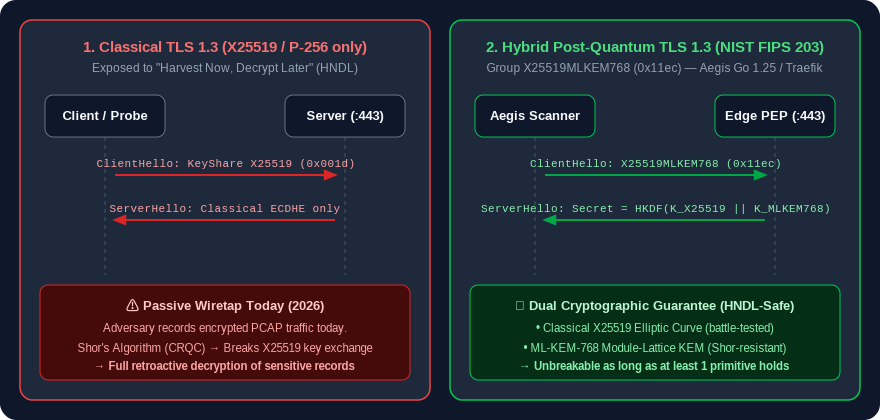
Figure 1: Why a classical elliptic-curve key exchange (X25519 alone) recorded in 2026 faces retroactive decryption, and how hybrid X25519MLKEM768 (0x11ec) encapsulation neutralizes the threat.
The Mechanics of an HNDL Attack
When your server negotiates a standard TLS 1.3 session today, Perfect Forward Secrecy relies on Elliptic Curve Diffie-Hellman Ephemeral (ECDHE) key exchange—typically X25519 or secp256r1 (P-256).
- In 2026 (Passive Collection): A state-backed adversary or traffic broker records encrypted PCAP streams containing the
ClientHello,ServerHello(with ephemeralX25519public keys), and theAES-256-GCMapplication ciphertext. - When Cryptanalytically Relevant Quantum Computers (CRQCs) Mature: Symmetric
AES-256remains safe (Grover’s algorithm only halves effective key strength to $2^128$ operations). However, Shor’s algorithm solves the Elliptic Curve Discrete Logarithm Problem (X25519) in polynomial time. - Retroactive Decryption: From the public key share recorded in 2026, the attacker reconstructs the ephemeral session secret and decrypts intellectual property, medical records, financial contracts, or OIDC tokens captured years earlier.
2. The Standardized Cure: NIST FIPS 203 Hybrid Key Encapsulation (X25519MLKEM768)
In August 2024, NIST finalized FIPS 203 (ML-KEM — Module-Lattice-Based Key-Encapsulation Mechanism, derived from CRYSTALS-Kyber), echoed by European cybersecurity agencies (such as ANSSI and BSI) recommending hybrid post-quantum key exchange.
Why hybrid? Rather than discarding two decades of battle-tested elliptic-curve cryptography overnight, the TLS 1.3 X25519MLKEM768 group (IANA codepoint 0x11ec) combines both secrets inside the TLS 1.3 HKDF key schedule:
SharedSecret_Final = HKDF-Extract( K_X25519 || K_ML_KEM_768 )K_X25519(32 bytes): Classical elliptic-curve Diffie-Hellman shared secret.K_ML_KEM_768(32 bytes): Post-quantum secret protected by the hardness of the Module-LWE (Learning With Errors) lattice problem.- Core Zero-Trust Guarantee: The session key remains computationally unbreakable as long as at least one of the two primitives holds.
How the Aegis v1.1 Passive Scanner Audits Your Domains (Go 1.25)
By upgrading the Aegis Control Plane to Go 1.25, the standard crypto/tls package natively supports tls.X25519MLKEM768 (0x11ec) and exposes the negotiated group via tls.ConnectionState.CurveID.
In apps/backend/internal/scanner/pqc.go, our passive probe InspectDomainPQC performs a non-intrusive 3-second TLS 1.3 handshake offering X25519MLKEM768 as its top preference:
conn, err := tls.DialWithDialer(dialer, "tcp", net.JoinHostPort(host, "443"), &tls.Config{
    ServerName:         host,
    InsecureSkipVerify: true, // Passive cryptographic layer audit regardless of X.509 chain
    MinVersion:         tls.VersionTLS12,
    CurvePreferences: []tls.CurveID{
        tls.X25519MLKEM768,            // 0x11ec — Official NIST FIPS 203 Hybrid Group
        tls.CurveID(0x6399),           // 0x6399 — Pre-standard X25519Kyber768Draft00
        tls.X25519,                    // 0x001d — Classical ECDHE Fallback
        tls.CurveP256,
    },
})
When a target server falls back to classical X25519 or P-256, Aegis raises a PQC-HNDL-EXPOSURE warning and outputs ready-to-paste configuration snippets for Traefik v3.3+, Nginx (OpenSSL 3.5+), and Caddy:
# Immediate Traefik / Dokploy remediation snippet generated by Aegis
tls:
  options:
    default:
      minVersion: VersionTLS13
      curvePreferences:
        - X25519MLKEM768
        - X25519
        - CurveP256
3. Governing AI Agents & MCP: The “Two-Door & Zero-Secret Placeholder” Architecture
The second major takeaway from 2026 enterprise AI deployments is the acute vulnerability of autonomous AI agents. Through the Model Context Protocol (MCP), engineering teams are wiring LLMs directly into PostgreSQL databases, Git repositories, ticketing systems, and internal APIs.
Conventional agent deployments suffer from two structural flaws:
- Plaintext API Secrets Inside the Agent Sandbox: Developers routinely pass live credentials (
OPENAI_API_KEY,STRIPE_SECRET_KEY, internal tokens) into the agent container’s environment variables. A single Indirect Prompt Injection (e.g., summarizing an untrusted email or web page) can trick the agent into exfiltrating its own environment variables. - Unfiltered MCP Tool Catalogs: When an MCP server exposes 30 tools via
tools/list, the agent sees—and can be manipulated into invoking—destructive write/delete tools even when the user’s task only requires read access.
To eliminate both risks without Kubernetes service-mesh bloat, the Aegis Roadmap (Locks #10 and #11) introduces the “Two-Door” (Ingress + Egress) architecture paired with the Zero-Secret Placeholder pattern:
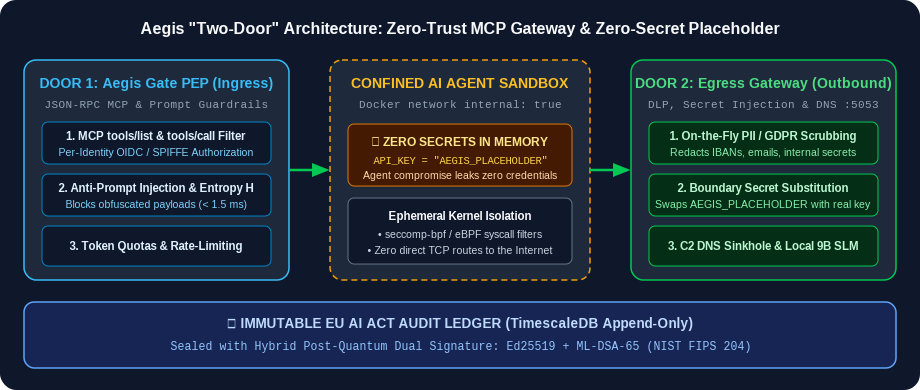
Figure 2: The “Two-Door & Zero-Secret Placeholder” pattern: the confined AI agent holds zero real keys in memory; Aegis filters MCP tools at ingress and injects credentials strictly at the outbound boundary after PII scrubbing.
Door 1 (gate-proxy Ingress): Per-Identity MCP Tool Filtering & Prompt Guardrails
Positioned in front of internal MCP servers and AI endpoints, the ingress gateway inspects JSON-RPC MCP traffic in under 1.5 milliseconds:
- Dynamic
tools/listandtools/callFiltering: Based on the caller’s OIDC identity (issued by the Aegis Pure BFF) or SPIFFE workload identity,gate-proxystrips unauthorized tools fromtools/listresponses and blocks out-of-policytools/callinvocations before they ever reach the tool server. - Mathematical & Heuristic Guardrails: Shannon Entropy ($H$) scoring and deterministic rules block obfuscated Base64/Hex payloads used in jailbreaks and indirect prompt injections.
The Confined Core: Zero Secrets in Memory (Zero-Secret Placeholder)
The AI agent runs inside an isolated Docker/Linux network (internal: true, with zero direct routes to the public Internet) constrained by ephemeral seccomp-bpf syscall filters:
- Inside its
.envor runtime memory, the agent holds zero real API keys—only a dummy placeholder token:API_KEY="AEGIS_PLACEHOLDER_KEY". - Security Impact: Even if an attacker achieves a total Prompt Injection and instructs the agent to dump its environment variables, the leaked value is a useless placeholder string.
Door 2 (egress-gateway Outbound): On-the-Fly PII Scrubbing & Boundary Secret Substitution
Every outbound request from the agent to an external LLM provider or third-party API must traverse egress-gateway:
- On-the-Fly GDPR / PII Scrubbing: The outbound gateway inspects JSON payloads to redact regulated PII (IBANs, national IDs, customer emails, proprietary source code) before it leaves the sovereign perimeter.
- Boundary Secret Substitution: If and only if the destination is whitelisted and the payload passes DLP inspection,
egress-gatewayswapsAEGIS_PLACEHOLDER_KEYwith the real API credential stored in its isolated vault. - Post-Quantum Signed Immutable Audit Ledger (EU AI Act Compliance): Every MCP tool invocation and external model call is recorded in an append-only TimescaleDB ledger sealed with a hybrid classical + post-quantum dual signature (
Ed25519 + ML-DSA-65— NIST FIPS 204), ensuring long-term tamper-evident non-repudiation.
4. Comparison: Hyperscale “AI Factories” vs. Aegis Sovereign Sobriety
| Dimension | Hyperscale “AI Factory” Stacks (OpenShift 5 / SUSE AI / PaletteAI) | Sovereign & Frugal Aegis v1.1 Approach (AGPLv3) |
|---|---|---|
| Target & Prerequisites | Fortune 500 enterprises, multi-node K8s clusters + NVIDIA GPU farms | From a €5/mo VPS (Docker / Dokploy) up to Bare-Metal & K8s |
| Memory Footprint (RAM) | Tens of gigabytes of RAM just for the control plane | < 200 MB RAM for the full core stack (Go + Rust + Node/TS + CoreDNS) |
| Post-Quantum Audit (PQC) | External scanners or heavy service mesh (Istio / Cilium) | Built-in (v1.1): passive X25519MLKEM768 (FIPS 203) probe + copy-paste snippets |
| AI Secret Protection | Complex distributed vaults (HashiCorp Vault + ESO) | Zero-Secret Placeholder pattern built into egress-gateway |
| Hardware Energy Metering | Macro estimates or GPU-only telemetry | Direct Intel/AMD RAPL silicon counters + CSRD / EFRAG PDF certificates |
Conclusion: Frontier Security Should Not Be a Fortune 500 Privilege
Transitioning to Post-Quantum Cryptography (NIST FIPS 203 / 204) and governing autonomous AI agents (MCP) must not become an excuse for hardware bloat or exclusionary SaaS pricing.
With Aegis v1.1 released under the GNU AGPLv3 license, any sysadmin, CTO, or SMB leader can immediately:
- Passively audit Post-Quantum TLS readiness (
X25519MLKEM768), security headers, hierarchical DNS (SPF/DMARC), and RGESN EcoIndex scores in under 3 seconds. - Shield web applications in-line (
< 1.5 ms) against exploit bursts (CVE-2024-4577PHP2Shell, SQLi, XSS) while cutting CPU electrical power waste under attack by 4.3×. - Prepare AI agent deployments with a frugal, sovereign Zero-Trust architecture aligned with NIS 2 and the European AI Act.
🎤 KubeCon + CloudNativeCon Europe (CFP): The “Two-Door MCP Gateway” architecture, zero-secret agent confinement, and air-gapped local decision SLMs are featured in Nicolas BAUD’s talk proposal for KubeCon Europe:
👉 “Hardening Agentic AI at the Edge: Zero-Trust Gateways and Air-Gapped Decision SLMs” — View Talk Proposal & Speaker Profile on Sessionize
🔗 Further Reading & Resources
- Try the Live PHP2Shell Hardware Replay, Fuzzer & PQC Scanner: https://demo.aegis.aivo.fr
- Explore the Source Code & Release v1.1.0 on GitHub: github.com/aivo-labs/aegis
- Read the Official Passive Scanner & PQC Probe Documentation: Aegis Docs — Passive Scanner & ML-KEM
- Read the Full Aegis Sovereign Gate Case Study: Aegis Case Study on aivo.fr
- Follow Our KubeCon Europe CFP: sessionize.com/nicolas-baud

Nicolas BAUD
Solutions Architect and Fractional CTO with over 15 years of experience, Nicolas BAUD assists organizations in securing their IT infrastructure, deploying sovereign AI architectures, and implementing software eco-design.