
In just a few months, application security has shifted fundamentally. Until recently, most hostile traffic hitting an exposed server looked like predictable mechanical noise: curl, sqlmap, or nuclei scripts blindly replaying static lists of known CVEs.
The emergence of ARTEX, an autonomous LLM-driven pentesting framework released in July 2026 before being taken down by its author in October 2026 after widespread weaponization, alongside peers like PentestGPT, Hexstrike, and CyberStrikeAI, has ushered in a new reality: the attacker is no longer a static script; it is an autonomous reasoning loop that observes, adapts, and chains exploits in real time.
For enterprises, SMBs, and hosting providers, the question is no longer whether automated scanners will probe their infrastructure, but how a system can withstand an AI that reads its HTTP responses.
Here is how these offensive agents operate and how we engineered Aegis Shield v1.3 (“Anti-Artex”) to turn their own autonomy against them.
1. Why Traditional Defenses Fail Against ARTEX-Style Agents
A traditional WAF relies on static logic: a request arrives, matches (or misses) a regex signature, and the server returns a generic or explicit error.
An autonomous offensive agent operates on a Planner $\rightarrow$ Workers $\rightarrow$ Observation loop:
- A Planner LLM decomposes a high-level goal (“gain admin access” or “extract environment secrets”) into parallel sub-tasks.
- Specialized Workers fire HTTP probes, inspect API schemas (
/openapi.json,/swagger.json,/graphql), sweep sequential IDs (BOLA/IDOR), and mutate payloads. - Closed-loop Observation is the agent’s sharpest weapon: if a WAF blocks a payload and leaks “Blocked by rule SQLI_UNION_SELECT”, the LLM reads the error, infers which filter stopped it, re-encodes the payload in Base64, hex, or URL-encoded variants, and retries seconds later.
Even worse, these agents chain discoveries autonomously. If one worker uncovers a debug endpoint or session token, another worker on a different IP can immediately replay it elsewhere.
2. Anatomy of an Autonomous AI Attack (4 Stages)
Analyzing ARTEX and modern offensive MCP frameworks reveals four recurring patterns:
- Browser mimicry: Workers send full Chrome/Firefox
User-Agentheaders to bypass naive blocklists, while omitting structural browser headers (Sec-Fetch-Site,Sec-Fetch-Mode,Accept-Language). - Accelerated API mapping: The agent hunts for blueprints first (
Swagger,OpenAPI, GraphQL__schemaintrospection) before sweeping object IDs (/api/v1/invoices/1001,1002,1003…). - Blind exfiltration (OAST): To confirm blind SSRF or RCE, the AI injects external callback domains (
interact.sh,oast.pro,burpcollaborator.net) or ephemeral tunnels (ngrok,trycloudflare.com). - Session theft & replay: Any leaked secret or cookie is stored in a shared blackboard for immediate reuse by other workers.
3. Inside Aegis Shield v1.3: 5 Sovereign Layers to Neutralize Offensive AI
Rather than playing whack-a-mole with isolated regexes, Aegis Shield v1.3 breaks every single stage of the attacker LLM’s decision loop.
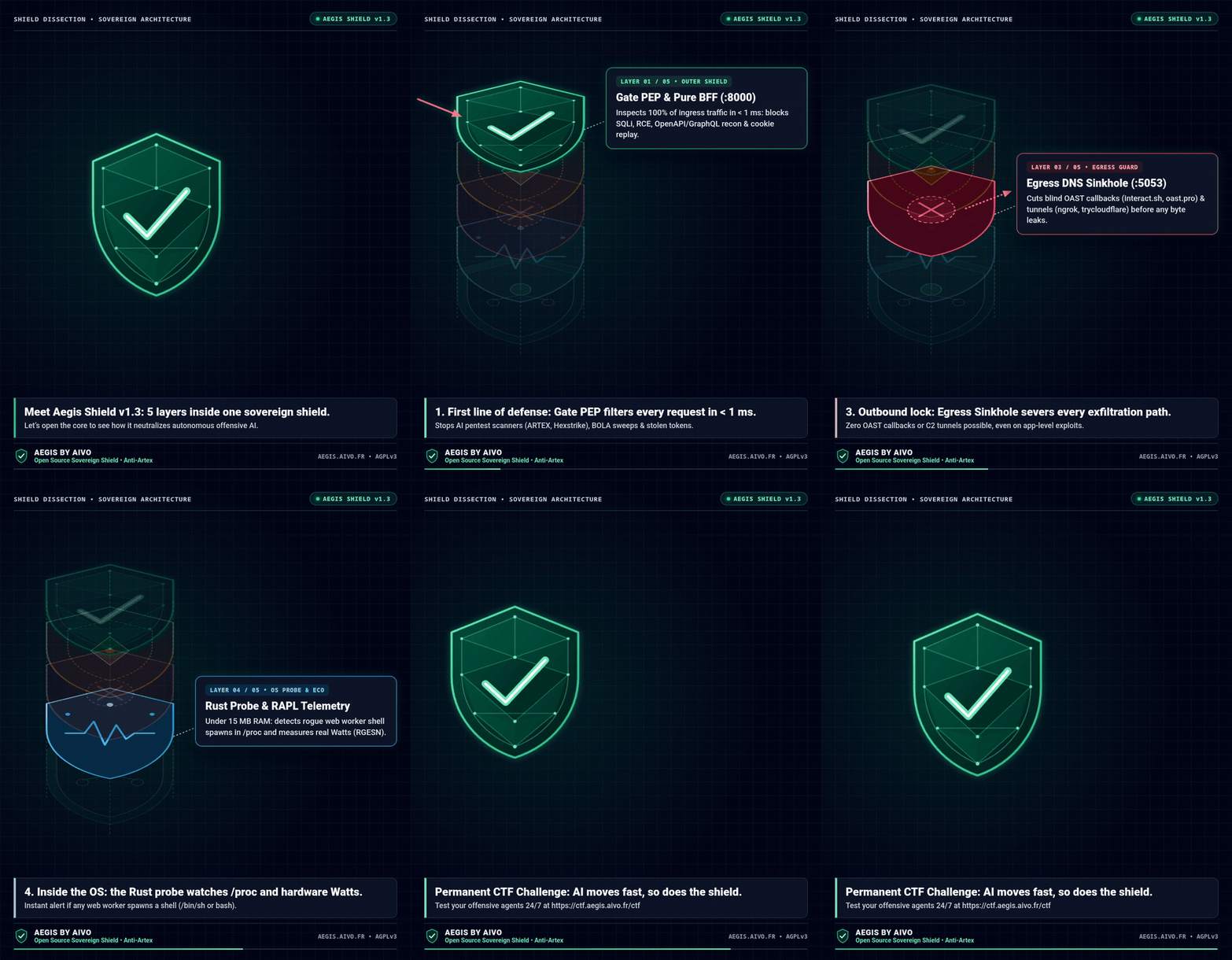
Layer 1 - Gate PEP & Pure BFF (:8000): Zero Hints, Zero Replay
- AI fingerprint detection:
Gate PEPinspects 100% of ingress traffic in under 1 ms, blocking known AI pentest agents and spoofed browser headers missingSec-Fetch-*metadata. - Schema lockdown & Anti-BOLA: Unauthorized OpenAPI/Swagger/GraphQL introspection and sliding-window sequential ID enumeration are intercepted immediately.
- Session Context-Binding: Under the Pure BFF pattern, AES-256-GCM session cookies are cryptographically bound to the client’s
User-Agentand/24IP subnet. Even if an AI agent steals a cookie, replaying it from another worker fails.
Layer 2 - Active Deception: Canary Honeypot, Stealth Mode & Tarpit
Instead of merely blocking the AI, Aegis actively traps it:
- Opaque
STEALTH_BLOCKmode: When enabled, Aegis never reveals which rule triggered the block (returning a genericSECURITY_POLICY_VIOLATION). The LLM loses its oracle. - Canary Honeypot (
/.env.canary): When an agent hunts for exposed config snapshots, Aegis serves a decoy file containing signed canary secrets (ak_live_aegis_canary_*). The moment the autonomous agent extracts and replays that key, the tripwire fires: instant 60-minute Auto-Jail ban. - Adaptive Tarpit: Repeated offenses progressively delay responses (
3 s$\rightarrow$7 s$\rightarrow$15 s), draining the attacker’s time and token budget with zero backend CPU impact.
Layer 3 - Egress DNS Sinkhole (:5053): Severing Leaks at the Source
Even in a worst-case scenario (an unpatched app-level zero-day), an ARTEX-style agent still needs outbound connectivity to exfiltrate data or confirm blind callbacks.
Aegis’s Egress Sinkhole intercepts outbound DNS lookups and immediately severs OAST domains (interact.sh, oast.pro, webhook.site, canarytokens.com) and Living Off Trusted Cloud tunnels (ngrok, trycloudflare.com, transfer.sh).
Layer 4 - Rust OS Probe & RAPL Energy Telemetry (< 15 MB RAM)
Written in Rust, the host probe continuously monitors /proc to catch any web worker attempting to spawn a shell (/bin/sh, bash), while measuring real hardware power draw in Watts.
Layer 5 - Go Control Plane & 3-Second Fleet Immunity
All Edge nodes, across OVHcloud, Google Cloud, or Bare-Metal, report to a central Go + TimescaleDB Cockpit. An attacker banned on one node is propagated and blocked across the entire fleet within 3 seconds.
4. A Permanent Red Team Challenge: Battle-Test Aegis at ctf.aegis.aivo.fr
Because AI models evolve every month, a security shield can never rest on yesterday’s benchmarks.
We have deployed a permanent, fully isolated Google Cloud Edge node (e2-small, streaming live telemetry to our central Cockpit), open to security researchers, developers, and ethical hackers:
- Target:
https://ctf.aegis.aivo.fr/ctf - Goal: Map the exposed surface and capture the protected flag at
/api/v1/ctf/flag - Allowed: Autonomous AI pentest agents (ARTEX, PentestGPT, CyberStrikeAI, Hexstrike) and L7 WAF evasion
- Prohibited: Volumetric L3/L4 network DDoS against cloud infrastructure
Every blocked attempt and every creative bypass helps us continuously harden Aegis Open Source (AGPLv3).
👉 Source code & 1-command deploy: github.com/aivo-labs/aegis
👉 Explore the Aegis ecosystem: aegis.aivo.fr

Nicolas BAUD
Solutions Architect and Fractional CTO with over 15 years of experience, Nicolas BAUD assists organizations in securing their IT infrastructure, deploying sovereign AI architectures, and implementing software eco-design.