

A few weeks ago, while reviewing metrics on our production VPS hosted at OVHcloud (which runs our platform, our n8n automation engines, and several web applications), a distinct pattern caught my eye in the raw Traefik reverse proxy logs.
At 3:00 AM, when our European clients, team members, and users were fast asleep, the server was steadily processing an uninterrupted stream of incoming HTTP requests. Dozens every minute. Thousands every single night.
For any experienced system engineer or developer, this is nothing new: the public Internet is under perpetual reconnaissance. Thousands of botnets, zombie crawlers, credential harvesters, and automated vulnerability scanners sweep the global IPv4 address space 24/7/365.
However, after deploying a direct hardware telemetry agent (Intel/AMD RAPL and Linux kernel /proc/stat probes) and graphing real-time electrical power dissipation, a second, far more critical truth emerged: this background noise is not free. Every hostile packet hitting your network interface wakes up the processor silicon, forces CPU cores out of low-power sleep states, and consumes real, measurable Watts.
Here is the technical autopsy of what actually happens on an exposed server, and how to eliminate this parasitic overhead at the network edge.
1. Deconstructing the Noise: What Actually Hits a Public Server in 2026?
To quantify the phenomenon, we analyzed 14 consecutive days of incoming traffic across our production edge gateway using our open-source Zero-Trust PEP suite, Aegis. Out of 180,000 total HTTP requests recorded during this window, nearly 52% originated from automated scanners, zombie botnets, and credential stuffing tools.
Here is the breakdown of the four primary threat categories hitting your infrastructure every day:
┌────────────────────────────────────────────────────────────────────────┐
│                   BREAKDOWN OF INCOMING HOSTILE NOISE                  │
├───────────────────────────────────┬───────────────┬────────────────────┤
│ Probe Category                    │ Traffic Share │ Example Targets    │
├───────────────────────────────────┼───────────────┼────────────────────┤
│ 1. CMS & Zombie PHP Botnets       │     44 %      │ /wp-login.php      │
│                                   │               │ /xmlrpc.php        │
│                                   │               │ /wp-admin/admin.php│
├───────────────────────────────────┼───────────────┼────────────────────┤
│ 2. Secret Scavengers (.env leaks) │     28 %      │ /.env, /.git/config│
│                                   │               │ /.aws/credentials  │
├───────────────────────────────────┼───────────────┼────────────────────┤
│ 3. Automated Reconnaissance       │     19 %      │ Nikto, ZGrab,      │
│                                   │               │ Censys, Masscan    │
├───────────────────────────────────┼───────────────┼────────────────────┤
│ 4. CVE Exploits & Heavy Payloads  │      9 %      │ SSRF, SQLi,        │
│                                   │               │ Overflows (413)    │
└───────────────────────────────────┴───────────────┴────────────────────┘
The Paradox of WordPress Probes on Stacks with Zero PHP
The most striking finding is the relentless volume of botnets hunting for legacy PHP and WordPress vulnerabilities. Our entire infrastructure is built on modern, lightweight, compiled architectures: Astro, Vue 3, Go 1.25, Node.js, and Rust. There is not a single .php script anywhere on the filesystem, nor is any PHP runtime installed.
Yet every single day, our proxy receives hundreds of POST requests attempting to bruteforce /wp-login.php or query vulnerable WordPress plugin endpoints (/wp-content/plugins/revslider/, /wp-includes/wlwmanifest.xml). Modern botnets do not bother identifying your stack beforehand: they spray every reachable IP address on port 80 and 443 indiscriminately.
The Aggressive Search for Leaked Secrets
The second most frequent vector targets developer oversights and misconfigured storage buckets:
GET /.envGET /.git/configGET /.vscode/sftp.jsonGET /docker-compose.yml
These scanners look for OpenAI API keys, AWS credentials, database passwords, or private signing tokens inadvertently left in publicly accessible web roots.
2. The Physics of a Network Packet: Why Ignoring These Requests Wastes Power
A widespread misconception among software developers and cloud architects is:
“My web application returns an HTTP 404 Not Found in under 2 milliseconds, so the performance and resource impact is completely negligible.”
This is an architectural illusion. From the perspective of the operating system kernel and physical server hardware, serving even a simple 404 response triggers a substantial cascade of resource allocation:

Figure 1: Cascade of hardware and software interrupts triggered by unshielded edge attack requests
The Interruption of CPU C-States
On modern server processors (Intel Xeon, AMD EPYC), energy efficiency relies fundamentally on C-states (CPU sleep modes). At idle, an unused processor core drops into deep sleep states (C6 or C7), where its operating voltage is drastically lowered and core clocking is nearly disabled. In this state, power draw drops to fractions of a milliwatt.
When a botnet hammers your server with a burst of 50 requests per minute, the processor cores are constantly interrupted by incoming network interface hardware interrupts (NIC IRQ). The CPU is physically prevented from entering deep C-states.
The cores remain trapped in active execution mode (C0) or light halt (C1), forcing the server to maintain elevated clock frequencies (P-states) and dissipate electrical energy as heat—even though no legitimate business workload is being processed!
Empirical Measurement in Joules and Watts
By combining RAPL (Running Average Power Limit) hardware counters with kernel-level /proc/stat jiffy tracking in our telemetry agent, we quantified this hidden energy drain:
- Server with unshielded, raw edge ingress: Baseline idle CPU load fluctuated between 6% and 11%, with average total power draw hovering at 12.8 Watts.
- Same server with Zero-Trust PEP filtering at the reverse proxy boundary: CPU load plummeted to 4.2%, and power draw stabilized down to 8.8 Watts.
That is a constant, unyielding delta of 4 Watts, 24 hours a day, 365 days a year.
Over a single year on one modest VPS, this parasitic noise represents:
ΔE = 4 W × 24 h × 365 days = 35.04 kWhAcross a corporate fleet of 50 or 100 cloud instances, this automated cyber noise burns megawatt-hours of unnecessary electricity, emits hundreds of kilograms of Scope 2 CO₂, and evaporates thousands of liters of clean water through datacenter cooling systems (WUE).
3. The Architecture Fix: Zero-Trust Policy Enforcement (PEP) at the Edge
How do you eliminate this waste? Definitely not by adding security middleware inside your business applications (e.g., Express.js, Spring Boot, Laravel, or Django). By the time an incoming packet reaches your application container, the memory has already been allocated and the CPU cores have already spun up.
The correct architectural pattern is to position an ultra-lightweight Policy Enforcement Point (PEP) directly at the reverse proxy ingress layer (Traefik).
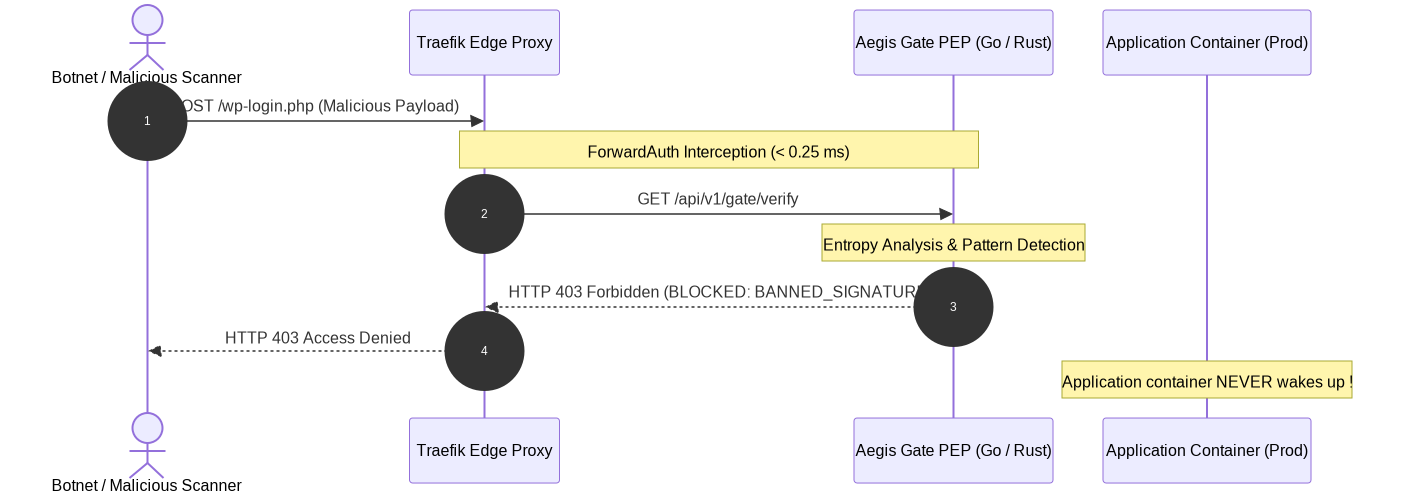
Figure 2: ForwardAuth edge interception in 0.25 ms: hostile dropped without waking the application container
Turnkey Traefik ForwardAuth Integration
Rather than deploying heavy proprietary appliances, Traefik features a battle-tested native mechanism: the forwardAuth middleware.
Here is the exact dynamic configuration (dynamic.yml) we deployed:
http:
  middlewares:
    aegis-gatekeeper:
      forwardAuth:
        address: "http://aegis-gate-proxy:8000/api/v1/gate/verify"
        trustForwardHeader: true
        authResponseHeaders:
          - "X-Aegis-Decision"
          - "X-Aegis-Risk-Score"
          - "X-Aegis-Event-ID"

  routers:
    all-services-router:
      rule: "HostRegexp(`{host:.+}`)"
      middlewares:
        - aegis-gatekeeper
      service: noop-service
Why This Architecture Changes Everything:
- Sub-0.25ms In-Memory Decision Time: The Aegis PEP evaluates request paths, headers, entropy, and payload signatures in less than a quarter of a millisecond.
- Absolute Container Shielding: If the request matches a hostile signature (
/wp-login.php,/.env, SQL injection patterns), Traefik drops the connection immediately with an HTTP 403. - Application Runtimes Stay Asleep: Your core workloads (Next.js frontends, n8n automation instances, Postgres databases) never receive a single rogue packet. Their event loops remain completely silent.
- Instant Virtual Patching: When a critical zero-day CVE is discovered in an open-source library, a single regex rule on the PEP neutralizes it edge-wide, without requiring code rewrites, recompilations, or container restarts.
4. Ground Results: The Dashboard After Remediation
Following the deployment of this Zero-Trust PEP on our sovereign node, the production metrics spoke for themselves:
- Instant Block Rate: Over 1,200 automated probes and exploits stopped cold at the reverse proxy every day.
- CPU Footprint: Baseline CPU utilization dropped from 11% down to a smooth 4.2%.
- Electrical Power: Stabilized at 8.82 Watts on our OVHcloud virtual private server.
- Full Operational Traceability: Every blocked event is correlated with source IP geolocation, threat category, and real-time energy savings.
Conclusion: True Green IT Begins with Robust Cybersecurity
For decades, cybersecurity was perceived as an expensive overhead that burdened systems. Organizations piled on heavy runtime agents, bloated application firewalls, and invasive scanners that bogged down infrastructure.
By shifting paradigms—filtering threats at the absolute network perimeter using compiled, frugal languages like Go and Rust—cybersecurity becomes the primary catalyst of digital sobriety.
By eliminating the hostile background noise that pollutes public servers, we don’t just protect our data: we give our processors the physical right to rest in deep low-power states, systematically shrinking the true environmental footprint of our digital infrastructure.
Resources & Getting Started
The tooling described in this article is open-source under the AGPLv3 license as part of the Aegis sovereign security and telemetry suite:
- 🧪 Interactive Sandbox & PHP2Shell Hardware Replay: https://demo.aegis.aivo.fr — Replay the real-world PHP2Shell (
CVE-2024-4577) hardware power benchmark (5.81 W/0% CPUwith Aegis vs24.14 W/743.4% CPUunshielded) and test payloads in the live fuzzer without installing any software. - 📦 Source Code & Deployment: Aegis GitHub Repository
- 📖 Architecture Documentation & Specs: aegis.aivo.fr
- 🎤 KubeCon + CloudNativeCon Europe CFP: “Hardening Agentic AI at the Edge: Zero-Trust Gateways and Air-Gapped Decision SLMs” — Nicolas BAUD on Sessionize
- 💡 Canonical Publication: aivo.fr/en/blog/anatomy-vps-under-siege-automated-scanners-energy

Nicolas BAUD
Solutions Architect and Fractional CTO with over 15 years of experience, Nicolas BAUD assists organizations in securing their IT infrastructure, deploying sovereign AI architectures, and implementing software eco-design.